In case there has been a doubt about my daughter’s nationality, and based on these words of wisdom, here is final proof:

In case there has been a doubt about my daughter’s nationality, and based on these words of wisdom, here is final proof:

One aspect of going home when you are the minority language parent is realising that “people understand me here”. By that I mean that I’m so used to no one around us understanding what I say to my three-year-old in public that I have to do a double-take when I’m back home and suddenly remember that the people next to us on the train, on the bus or in the coffee shop or department store will actually understand what I’m telling her.
Not that I’m talking about top secret or inappropriate subjects, but for some reason I do talk differently when I know there is someone else around who understands what I say.
Weird, eh?
Twitter is my friend for anything writing-related these days. But I also do a bit of bilingualism on the side, as several of my writer friends are expats and parents, too. This week I came across this wonderful website with really good advice for parents of bilingual or to-be-bilingual children:
As I quote in my diploma theses,
« Der Begriff Interferenz ist der Physik entlehnt und meint dort die Erscheinung, daß es durch die Überlagerung von Wellen (z.B. Radiowellen) zu Störungen kommt (z.B. Pfeiftöne im Radio). Auf die Situation des Zweisprachigen übertragen meint der Begriff, daß sich Regeln der beiden Sprachen überlagern und es dadurch zu Umstrukturierungen kommt, was sich nach außen in bestimmten Fehlern manifestieren kann. Der Übergang von der Sprachmischung zur Interferenz ist fließend. Sprachmischung ist im allgemeinen jedoch direkter wahrnehmbar und auch bewußter als Interferenz, weil Elemente beider Sprachen als Fremdkörper aufeinanderstoßen. Bei der Interferenz wirken die Sprachen indirekt aufeinander, es kommt zu internen Veränderungen, die nach außen nicht immer zu erkennen sind. »
(Kielhöfer, Bernd/Jonekeit, Sylvie, Zweisprachige Kindererziehung, 1983, S. 64
interference in bilingualism basically means the influence of one language on the other. This very common phenomenon can be observed notably in the use of the grammatical structure of one language transferred to the other, or in the literal translation of idiomatic expression.
My daughter is still in the early stages of bilingualism, and there are two classic interference sentences that I hear from her regularly:
“Du nimmst eine Dusche?” (from French: “Tu prends une douche?” when German should be “Du duschst?”)
and
“Ich habe kalt.” (from French: “J’ai froid.” when German should be “Mir ist kalt.”)
(The latter example is usually considered wrong in Germany, but when I lived in the borderland town of Saarbrücken, I learned that it is an acceptable phrase to use there.)
In both cases, her weaker language (German) was influenced by her stronger language (French).
This morning, I can’t remember in what context, my daughter (now almost 3½) said:
“Je vais couper ein bisschen was ab.”
Switch in mid-sentence without any trigger that I can see. (Maybe too early for the “switch-at-trigger” phase.)
Did you notice the prefix “ab” placed in the final position (where it would belong if the sentence were in the present tense)?
For comparison, here is the sentence in German and in French:
“Ich werde ein bisschen was abschneiden.”
“Je vais couper un petit bout.”
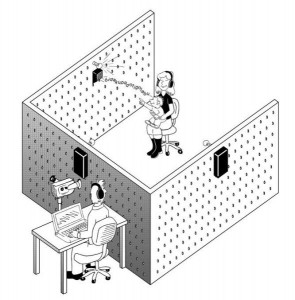
L’équipe du Labo Bébé de l’université Paris Descartes a publié son premier newsletter sur leur recherche. J’aime bien l’illustration de la cabine insonorisée:

Vous pouvez lire leur newsletter en cliquant ici (fichier PDF).
Today I came across this article on a UK website:
Languages – Gift of bilingualism is too often ‘squandered’
Some quotes:
[Professor Joseph Lo Bianco, of the University of Melbourne] who advised the Australian government on its languages policy, said it was of “critical importance” that education systems across the world fostered a “multilingual mentality”, with bilingual children being given a strong role to play.
Academics have suggested that there are as many bilingual children in the world as there are monolinguals.
And here I thought the French public school system had problems…
Will they ever learn?
The other day I was preparing my daughter for our upcoming dentist appointment. She had accompanied me to every single check-up since she was born, and half a year ago, she’d had her first very own check-up. As a reward, the dentist had let her choose a little plastic ring.
So I reminded her of that (no idea what’s become of that ring, though) and said that as a child, I’d received little gifts from the dentist, too. I even remembered them, small plastic cookie cutters.
Daughter’s comment: “Das ist nicht gut für deine Zähne.” (“That’s not good for your teeth.”)
Thanks, sweetheart 🙂
Yesterday we participated in the annual lantern walk (Laternelaufen) of the bilingual school an older friend of my daughter attends. Following the walk, I was queuing for sausages, enjoying the unusual situation of being surrounded by German speakers on all sides, when I overheard three girls (I guess they were about 9 years old) talk in French next to me. At one point, two of them exclaimed, addressing the third:
“What? You don’t like sausages? You’re not German!”
Yesterday when I picked her up from day-care (it’s the school holidays), my daughter told me what they’d been doing:
“We went by Nanny’s house, and then there was a big TV.”
Turns out she’s been to see her first movie at the local cinema. Already. I think I was six or seven when I saw my first movie. A Disney. The Rescuers, possibly. And a bit later, E.T. (Had me all confused with Gertie showing E.T. a video – how could she program their TV?)
The movie theatre was “a little dark”, by the way, “and then the film was over”.
She doesn’t even remember what the film was about (I asked “Were there animals?”). All the better because the movie I’ve scheduled for her in two weeks (our département organises “ciné-goûters”) might be the same one…